Industry & trade
Manufacturing & industrial B2B
Engineers buy on specs, tolerances and proof of capacity.
The short answer
A manufacturing or industrial B2B website works as the sales team's catalogue. Engineers and procurement buyers want to filter parts, compare specifications, check certifications and send a request for quote with drawings attached. Spec tables, a part finder, an RFQ list that follows the buyer and proof of capacity win export enquiries.
Must-haves, and why
A product catalogue with full spec tables: material, dimensions, tolerances, finish, standards engineers buy on numbers, not descriptions.
Filters and a part finder buyers who can't compare parts leave.
An RFQ list that follows the buyer across the site buyers can collect parts as they browse.
Secure, encrypted drawing upload with each request drawings are confidential intellectual property.
RFQs that arrive with company, country, material and quantity complete requests can be quoted without a follow-up call.
Search that understands part codes, sizes, aliases and typos buyers search by code and size, often with typos.
Capabilities and machine list, with capacity buyers check capacity before sending work.
Certifications: ISO 9001, IATF 16949 or others you hold many buyers can only source from certified suppliers.
Export markets served and Incoterms you work with overseas buyers want proof you ship to their country.
Sample tracking or order status where you offer it it saves calls and builds confidence before a bulk order.
Authority & trust signals
Pages to build
Common mistakes
- A catalogue only as a PDF.
- Specifications missing tolerances or standards.
- A generic contact form instead of an RFQ.
- Asking for drawings by email.
- Stock photos of factories instead of your own machines.
Our take · Aliasgar Barodawala
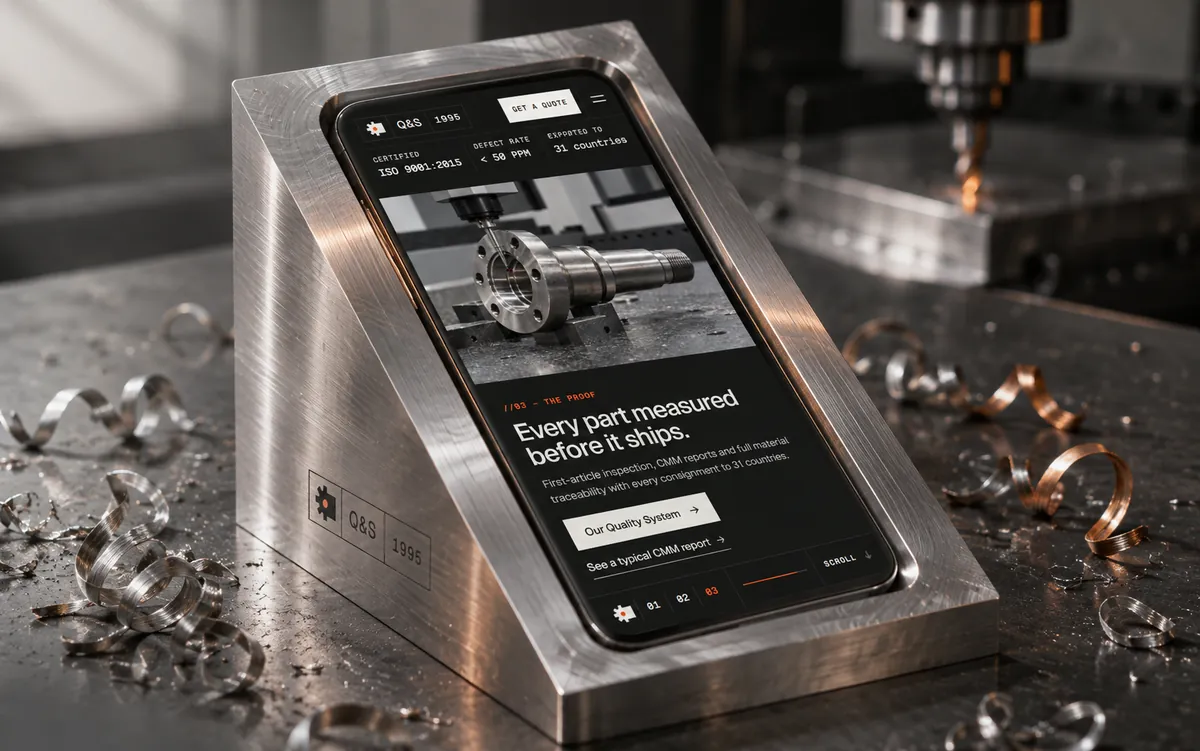
Quill & Spindle is a CNC exporter with 144 machined parts. Engineering buyers filter the catalogue, build an RFQ list that follows them across the site and send drawings through encrypted upload. Each RFQ arrives in the dashboard with company, country, material and quantity, and ends with an engineer-call booking. Every part has a full spec table, and a part finder narrows the catalogue as the buyer answers. Mobile performance on the home page went from 77 to 94 in local Lighthouse tests.
On Halar Precision, a brass components maker in Jamnagar, buyers search 96 parts by name, alias, size or part code, even with typos and trade synonyms, compare up to four side by side and track a sample by its ID. B2B sites fail when buyers can't compare parts. Filters and spec tables are the sales team.
Brands named here are my own self-initiated concepts unless marked Client work. Paid client work is under NDA.
B2B sites fail when buyers cannot compare parts. Filters and spec tables are the sales team.
From the work · Quill & Spindle
- The brief
A CNC exporter with 144 parts needed engineers to shortlist and request quotes online.
- What we did
A part finder with filters, an RFQ list that follows buyers across the site, encrypted drawing uploads and full spec tables on every part.
- What it does
Mobile performance on the home page went from 77 to 94, and RFQs arrive with material, quantity and drawings attached.
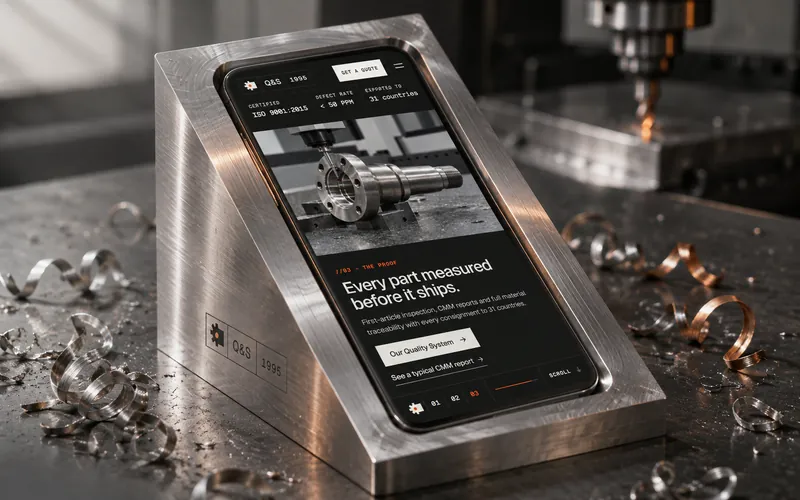 See the project · ManufacturingQuill & SpindleCNC precision parts · B2B exportEngineering buyers filter 144 machined parts, build an RFQ list that follows them across the site and send drawings with their request. Each RFQ arrives in Studio with c…
Search terms worth owning
- #CNC machining
- #precision components manufacturer
- #brass parts exporter
- #custom machined parts
- #RFQ
- #industrial parts supplier
Questions people ask
What should a manufacturing company website include?
A searchable catalogue with spec tables, a part finder, an RFQ list with drawing upload, capabilities and machines, certifications, industries and export markets served.
Should a B2B manufacturer show prices online?
Usually not, because price depends on quantity, material and tolerance. An RFQ that captures those details gets a buyer a real quote faster.
How should buyers send drawings?
Through encrypted upload attached to the RFQ, never by open email. Quill & Spindle and Halar Precision both work this way.
How do industrial B2B websites rank on Google?
One indexable page per part or part family, with the material, size and standard in the text, plus Product structured data and industry pages.
Does site search matter for a parts catalogue?
A great deal. Buyers type part codes, sizes and trade names, often with typos. Halar Precision's search handles aliases and typos.
How fast should a B2B website be?
Aim for 90 or more on Google PageSpeed for mobile. Quill & Spindle's home page reached 94, up from 77.
What a complete RFQ captures
An RFQ with these fields can be quoted without a follow-up call.
- Company and country
- Part or drawing
- Material and grade
- Quantity and delivery schedule
- Tolerances and finish
- Target date
Technical SEO for manufacturers
Industrial buyers search by part, material and standard.
- Product schema with additionalProperty for specs and mpn
- One URL per part family, variants in tables
- Industry and material landing pages
- Client-side search index with synonyms
- hreflang for export-market languages
Updated 7 Nov 2026 · Aliasgar Barodawala